
A propane forklift rarely lifts two and a half tons of anything you actually handle
Published: 26.AUG.2026



The number on the machine is a test result, not a promise
Canadian warehouses and yards review their fleets before the winter season, and every machine is compared on a single figure. A propane forklift rated at two and a half tonnes was measured under conditions that almost nothing in a real building matches.
That rating comes from a standard test with the load at a defined distance from the fork face and the mast at a defined height. Change either and the propane forklift's real capacity changes with it.
Propane forklift load center is the specification nobody reads
Load center describes how far the center of mass sits ahead of the fork face, and the standard figure is usually five hundred millimeters. That corresponds to a compact pallet with its weight evenly spread.
A deeper pallet, a long crate, or anything stacked toward the front pushes that center further out. Every additional distance is leverage against the counterweight, and capacity falls away steeply rather than gradually.
Why can my forklift not lift its rated weight has a chart for an answer
Manufacturers publish a capacity plate showing what the machine will lift at various load centers and mast heights. A machine of this class at a one meter load center may be rated well under two tonnes, and that plate is on the machine rather than in a drawer.
Height derates the machine as well
Raising a load moves it forward as the mast tilts and raises the combined center of gravity. Full capacity applies at low lift heights, and the same load at the top of a three stage mast may be outside what the machine will hold.
Attachments consume capacity before anything is lifted
A side shifter, a rotator, or a carton clamp weighs several hundred kilograms and hangs entirely ahead of the fork face. That weight counts against the rating twice over, as mass and as leverage, and it is why attachment fitted machines carry a revised plate.
Operators feel the limit before they read it
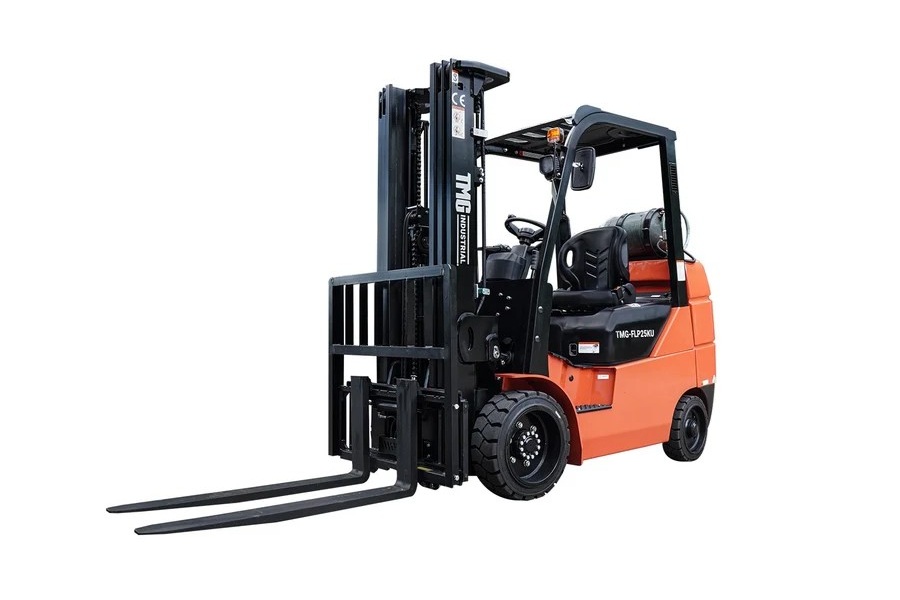
On a 2.5 ton propane forklift a machine approaching its limit becomes light at the rear and vague to steer, because the steered wheels are losing load. That sensation is the warning, and it arrives well before anything tips.
Capacity divides by what changes it
● Load center: the largest single effect.
● Lift height: derates at the top of the mast.
● Attachments: weight plus leverage, plated separately.
Where this capacity class fits and where it does not
● Strength: continuous running with quick refuelling.
● Strength: indoor capable with ventilation.
● Limit: rated figure applies at one load center.
● Limit: deep or awkward loads derate it sharply.
Weighed against a larger machine, this class costs capacity headroom on awkward loads and returns a footprint that works in ordinary aisles. A distributor near Calgary keeps a copy of the capacity chart at the dock, since the pallets arriving are deeper than the ones the rating assumed.
Fleets are being matched to the loads rather than the building
Operations increasingly size machines against the pallets and containers they actually handle rather than against aisle width and rack height, having found that the awkward loads decide the fleet rather than the average ones.
That way of specifying equipment is why the forklifts TMG Industrial supplies are described with their load center and capacity chart rather than by a headline tonnage.
Filed in: / Machines & Tools / Forklifts
Advertising