
Can Solar Battery Storage Power Your Whole House During a Blackout?
Published: 03.JUL.2026



When the power went out across parts of Texas during Winter Storm Uri in 2021, some homeowners with solar panels were surprised to learn their systems shut off too. Panels alone don't keep the lights on. The real question isn't whether you have solar — it's whether you've paired it with the right battery setup, and whether that setup can carry the actual load your house demands.
So can a solar battery run your whole house during an outage? Sometimes yes, sometimes no. Here's what makes the difference.
It Comes Down to Two Numbers
Every battery has two specs that matter during a blackout: capacity (how much energy it holds, measured in kilowatt-hours) and continuous power output (how much it can deliver at once, measured in kilowatts). Think of capacity as the size of your gas tank and power output as how hard you can press the accelerator.
A typical American home uses around 29 kilowatt-hours per day, according to figures published by the U.S. Energy Information Administration. But daily average isn't the whole story. Your air conditioner, well pump, and electric oven can spike demand for short bursts that a small battery simply can't cover — even if it has plenty of stored energy left.
That's why "whole-house backup" depends on matching both numbers to your home. A stackable lithium iron phosphate (LFP) setup — the chemistry most residential batteries now use because it runs cooler and lasts longer than older lithium-ion formulas — can be sized up as your needs grow. Modular packs like the BAT 6.0 and BAT 9.0 let a homeowner stack roughly 6 to 54 kilowatt-hours per tower, so a small apartment and a five-bedroom house aren't forced into the same box.
Whole-House vs. Partial Backup
There's a practical fork in the road here, and it's worth understanding before you buy.
● Whole-house backup keeps everything running — including big loads like central AC and electric water heaters. It needs a battery with high enough power output and enough capacity to ride out a long outage.
● Partial (or managed) backup protects the circuits that matter most: refrigerator, internet, a few lights, medical equipment. It's cheaper and stretches your stored energy further.
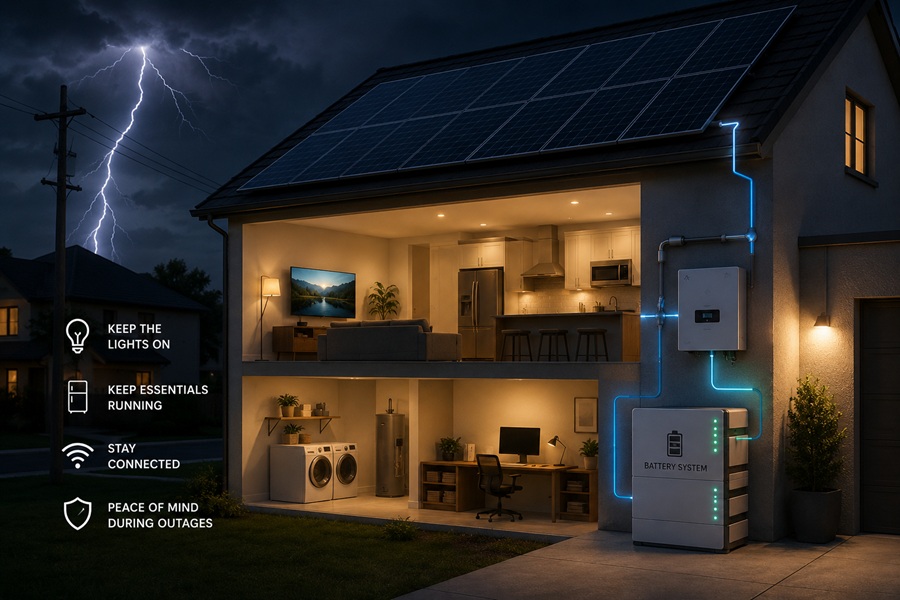
Many homeowners actually want a hybrid of the two. A smart backup manager, such as the Sigen LoadHub, can prioritize essential circuits automatically and shed non-critical loads when the battery runs low — so your fridge stays cold even if the pool pump goes idle. A well-designed home solar battery storage system does this switching in milliseconds, fast enough that most electronics never notice the grid dropped.
The Sun Has to Show Up Too
Batteries store energy; they don't create it. During a multi-day outage, whether your house stays powered indefinitely depends on recharging from your panels each day. This is where hybrid inverters earn their keep — they manage the flow between panels, battery, and home, and the better ones convert energy with very little waste. High-efficiency residential units now reach into the high-90s percent range, and independent testing by organizations like the National Renewable Energy Laboratory has documented how those conversion gains translate into more usable power over a system's life.
The math is simple in principle: if your panels generate more than you use during daylight, the surplus refills the battery for nighttime. Cloudy stretches and short winter days are the constraint. A honest installer will size your system around your worst-case week, not your best one.
So, What's the Verdict?
Yes — a properly sized solar battery can absolutely power an entire home through a blackout, sometimes for days. But "properly sized" is doing a lot of work in that sentence. The homeowner who wants seamless whole-house backup needs to look past sticker capacity and account for peak power draw, local sunlight, and which loads truly need protecting
If you're weighing your options, start by pulling a year of your utility bills and identifying your heaviest days. From there, comparing configurations on a platform that lets you model different battery and inverter combinations turns a guessing game into an informed decision — so the next time the grid stumbles, your house doesn't.
Filed in: / Renewable Energy / Energy Storage Systems
Advertising