
How DPF Trade-In Programs Support the Circular Automotive Economy
Published: 29.OCT.2026



For fleet operators, repair workshops, dismantlers, and commercial vehicle recyclers, a used diesel particulate filter can look like an awkward liability. It is bulky, contaminated with soot and ash, costly to store, and subject to handling requirements. Yet treating every removed filter as ordinary waste overlooks its remaining economic and environmental value.
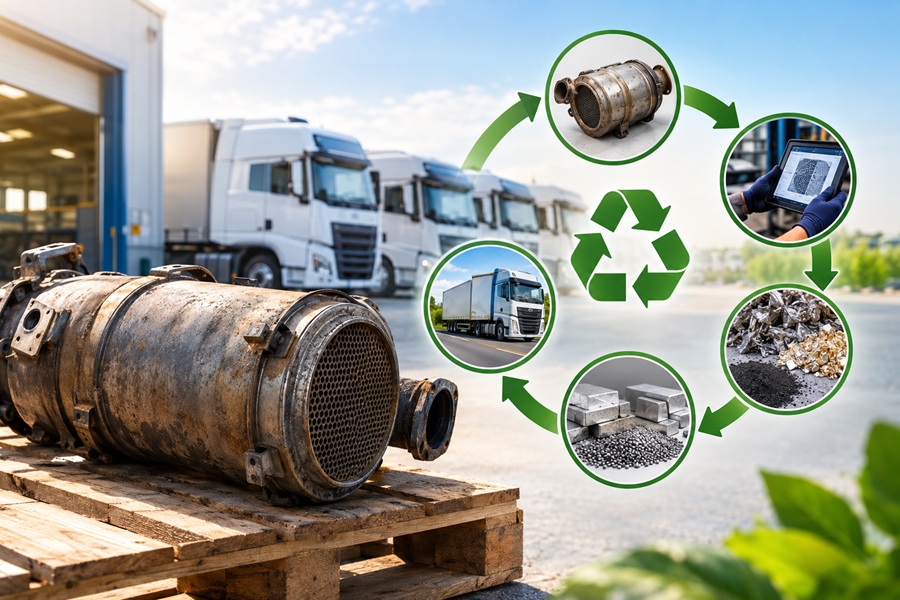
Well-designed trade-in programs change that equation. Instead of allowing used diesel emissions components to accumulate in storage or enter an unclear disposal route, these programs direct them toward inspection, evaluation, recovery, and responsible recycling. In doing so, they support a circular automotive economy in which products and materials remain productive for longer, while businesses gain a more transparent way to manage end-of-service components.
This matters because commercial vehicles generate significant material flows over their operating lives. A circular approach does not begin only when a vehicle is dismantled. It also applies to every replacement part removed during maintenance, including the dpf, catalytic units, oxygen sensors, electronic modules, and batteries.
Why Used DPF Units Should Not Be Treated as Ordinary Scrap
A diesel particulate filter captures particulate matter from a diesel engine's exhaust before it can be released into the atmosphere. During normal operation, regeneration burns off much of the accumulated soot. Over time, however, non-combustible ash, physical damage, thermal stress, oil contamination, or internal substrate failure may reduce performance to the point that cleaning is no longer practical.
At that stage, the unit still deserves structured evaluation. A DPF assembly may contain a ceramic or metallic substrate, a steel housing, and catalyst-coated materials. Depending on its design and application, related aftertreatment components may also contain platinum-group metals such as platinum, palladium, and rhodium. These resources required energy, mining, refining, manufacturing, and transportation to enter the original supply chain.
Discarding the complete unit without assessment can therefore create several losses at once:
● Recoverable material value is missed. Metals and catalyst-bearing materials may be suitable for specialized recovery.
● Waste management risk increases. Unverified disposal routes make it harder to demonstrate responsible handling.
● Storage space is consumed. Large commercial-vehicle components quickly occupy valuable workshop or yard capacity.
● Useful operational data disappears. Tracking removals can reveal failure patterns by vehicle model, mileage, duty cycle, or maintenance practice.
● Primary resource demand remains higher. Materials that could re-enter production are replaced entirely with newly extracted resources.
A trade-in program addresses these issues by establishing a repeatable route from removal to evaluation and onward processing.
How a Professional DPF Trade-In Program Works
The term "trade-in" can suggest a simple exchange, but a credible business-to-business program is more disciplined. It should define what is accepted, how units are identified, which data affect valuation, how transport is arranged, and what documentation is provided.
1. Identification and segregation
Accurate identification is the foundation of fair evaluation. Staff should preserve visible part numbers, manufacturer markings, vehicle information, and photographs whenever possible. Units should be separated from unrelated ferrous scrap rather than thrown into a mixed container where identification plates or housings may be damaged.
Segregation also improves safety and efficiency. Filters from passenger cars, heavy trucks, buses, construction machinery, and industrial diesel engines can differ substantially in size, design, composition, and handling needs. Sorting by category helps the receiving specialist plan logistics and choose an appropriate assessment method.
2. Condition review and data-based valuation
Not every used unit has the same value. Model, manufacturer, serial or part number, substrate condition, weight, completeness, contamination, and prevailing commodity indicators may all influence an offer. Where a mixed or processed lot cannot be reliably valued by identification alone, sampling or laboratory analysis may be necessary.
This is why transparent assessment is more useful than a generic price per unit. A professional buyer should be able to explain which characteristics affect the result. For Japanese businesses researching a DPF purchasing service (dpf 買取), the most important question is not merely who advertises the highest headline figure. It is whether the valuation is traceable, relevant to the actual material, and supported by a credible downstream recycling process.
3. Safe storage and transportation
Removed filters can contain soot, ash, sharp edges, and residual contamination. Businesses should keep them in a secure, dry, designated area and use suitable containers or pallets that prevent movement during transportation. Openings may need to be covered to reduce the release of loose material, while large truck units should be handled with equipment appropriate to their weight.
Transport planning is especially important for fleets and dismantlers generating high volumes. Consolidated collections can reduce administrative work, vehicle movements, and cost per unit. A specialist with nationwide coordination capabilities can also help businesses standardize procedures across multiple depots instead of arranging a different disposal method at every location.
4. Processing through an accountable route
After collection, units should move through a controlled process that may include verification, dismantling, sorting, substrate preparation, analysis, and material recovery. Steel housings and catalyst-bearing fractions follow different processing routes, while unsuitable residues require compliant treatment.
Traceability distinguishes a circular program from an informal scrap transaction. Records of quantities, categories, collection dates, assessment results, and processing routes help organizations demonstrate that materials did not simply disappear after leaving their premises.
The Business Case for Trade-In Programs
Environmental responsibility is a central benefit, but it is not the only reason to participate. A structured program can improve everyday operations and reduce hidden costs.
Turning an expense into a recoverable asset
Without a recovery arrangement, a removed filter creates storage, labor, and disposal costs. Data-based purchasing can return part of its residual material value to the business. Although returns vary by unit and market conditions, the principle is valuable: a component should be evaluated before it is classified as a cost with no remaining value.
Improving workshop productivity
Cluttered storage areas slow down staff, complicate inventory checks, and create preventable safety concerns. Scheduled collections and clear acceptance standards give technicians a simple procedure: identify the unit, record it, store it in the designated location, and release it through the approved channel.
Supporting environmental reporting
Companies are increasingly expected to understand what happens to their operational waste and recoverable materials. Collection records and transparent processing information can support internal sustainability metrics, supplier reviews, customer questionnaires, and environmental management systems.
Reducing exposure to uncertain buyers
Aftertreatment components can attract opportunistic purchasing because some contain valuable materials. Offers based only on visual inspection or unexplained prices may leave sellers unable to verify whether they received an appropriate valuation. A long-term relationship with a specialist reduces this uncertainty by establishing identification, documentation, pricing, and collection procedures in advance.
How Trade-Ins Strengthen the Circular Automotive Economy
A linear automotive system follows a familiar pattern: extract resources, manufacture a component, use it, and discard it. A circular system seeks to preserve utility and material value at each stage. DPF trade-in programs contribute to this model in several practical ways.
1. They create a return channel. Components flow back from workshops, fleets, and dismantlers to businesses equipped to assess and process them.
2. They improve material visibility. Identification and reporting make it easier to understand what is being recovered and where it goes.
3. They support secondary raw materials. Recovered metals can reduce reliance on virgin extraction and return to industrial supply chains.
4. They encourage design and maintenance insights. Aggregated information about failed or retired units can reveal which applications generate the most frequent replacements.
5. They align financial and environmental incentives. Businesses are more likely to segregate materials properly when responsible recovery also provides a fair economic return.
The wider impact becomes meaningful at scale. One filter may appear insignificant, but a national network of commercial workshops, logistics fleets, bus operators, and vehicle dismantlers produces a continuing stream of aftertreatment equipment. Consistent recovery practices can keep substantial quantities of metal and catalyst-bearing material in circulation.
What to Look for in a DPF Recovery Partner
The quality of the program depends heavily on the organization receiving the material. Before selecting a partner, businesses should assess more than the quoted price.
● Relevant specialization: Confirm that the company understands commercial-vehicle catalysts and emissions-control equipment rather than handling everything as undifferentiated scrap.
● Transparent valuation: Ask how part numbers, condition, weight, market data, and analytical results influence pricing.
● Analytical capability: For mixed, decanned, or high-volume materials, determine whether sampling and laboratory analysis are available.
● Clear documentation: Request collection records, item summaries, analysis reports where applicable, and information about the processing route.
● Safe logistics: Check whether the provider can advise on packaging, palletization, storage, and collection of heavy units.
● Responsive communication: A dependable partner should answer questions quickly and provide a defined point of contact.
● Responsible downstream processing: Seek evidence that materials move through appropriate recovery facilities rather than opaque intermediary channels.
Legend Metal reflects this specialist approach by serving business customers in Japan with collection, purchasing, evaluation, and recycling services for used automotive catalysts, large-vehicle catalyst units, electronic scrap, batteries, and related recoverable materials. Its emphasis on market data, item-specific information, analysis where appropriate, and traceable processing is particularly relevant to organizations that require both commercial value and accountability.
Practical Steps for Fleets, Workshops, and Dismantlers
Businesses do not need to redesign their entire waste system to begin. A focused pilot can establish whether a trade-in model improves recovery and administration.
1. Audit current volumes. Review how many DPF and related exhaust units were replaced during the past six or twelve months.
2. Map the existing route. Document where units are stored, who authorizes release, and what records are currently retained.
3. Create a no-damage procedure. Instruct technicians not to remove identification plates, unnecessarily cut housings, or mix units with general scrap.
4. Record essential details. Capture part numbers, vehicle type, removal date, condition, and photographs.
5. Designate secure storage. Use labeled containers or pallets in a controlled area, with suitable precautions for contamination and weight.
6. Request a documented assessment. Compare potential partners on methodology, logistics, reporting, responsiveness, and downstream responsibility—not price alone.
7. Measure the pilot. Track recovered revenue, storage days, staff time, collection frequency, and the number or weight of units diverted from disposal.
Once the process is proven, it can be extended to other material streams, including catalytic converters, oxygen sensors, printed circuit boards, automotive electronics, hybrid batteries, EV batteries, and industrial batteries. Using consistent recovery principles across these categories can turn fragmented disposal activity into a coherent resource-management strategy.
From Used Component to Managed Resource
The circular automotive economy depends on practical systems, not slogans. For diesel emissions equipment, that means identifying residual value, preventing avoidable damage, using safe logistics, applying defensible valuation methods, and sending materials through a traceable recovery route.
A well-run trade-in program gives fleet and automotive businesses a realistic way to participate. It clears storage space, improves records, returns recoverable value, and supports the recirculation of finite materials. Organizations with retired truck filters or mixed aftertreatment units should start by documenting their stock and requesting a transparent assessment from a specialist such as Legend Metal. That first inventory review can reveal that what appeared to be a disposal problem is actually an opportunity to improve both resource efficiency and operational control.
Filed in: / Environment / Catalyst Recycling
Advertising