
Looking for a Reliable Forklift AGV Supplier: What Professional Buyers Should Check
Published: 05.OCT.2026



Choosing the wrong forklift AGV supplier can leave a factory with vehicles that carry the specified weight yet fail at the pallet, aisle, rack, software, or service interface. The resulting problem is larger than a delayed robot project: an unreliable handoff can interrupt production, create manual recovery work, and lock capital into equipment that cannot support the intended material flow.
Professional buyers therefore need to assess the complete automated pallet handling system, not simply compare payload figures or headline prices. The strongest supplier is the one that can convert pallet drawings, route constraints, throughput targets, safety conditions, and software interfaces into a testable system proposal - not merely quote a vehicle with the required payload.
What Should a Forklift AGV Supplier Prove Before You Buy
A credible proposal should translate the buyer's operating conditions into a vehicle and system specification. That means documenting the load carrier, route, transfer points, required throughput, shift pattern, charging strategy, safety zones, and digital interfaces before finalizing a model or fleet size.
The supplier should begin with the pallet
Pallet geometry often determines project feasibility. Buyers should provide the pallet's external dimensions, bottom-deck structure, fork-entry direction, opening height, condition tolerance, maximum load, center of gravity, and any overhang.
A three-runner pallet, full-perimeter pallet, cage, rack, or custom carrier may require different fork dimensions and recognition logic. A supplier that asks only for load weight is not yet specifying an automated pallet handling solution.
The vehicle must fit the real route
Minimum aisle width, turning radius, floor flatness, gradients, door openings, rack clearances, cross-traffic, and emergency access should be checked against the loaded vehicle envelope. The route study must include pickup and drop-off approaches rather than measuring only the straight aisle.
For an operating plant, it should also identify pedestrian shortcuts, manual forklift crossings, temporary storage, and other conditions that can invalidate a clean layout drawing.
Which Forklift Robot Matches the Material Flow
Forklift automation covers more than one task. Horizontal pallet transfer, floor-level pickup, line-side delivery, buffer movement, rack putaway, and high-level stacking impose different mechanical and navigation requirements. The supplier should explain why a selected configuration matches the process and where another AGV or AMR type would be more appropriate.
Horizontal transport needs a stable low-lift configuration
When pallets move between receiving, storage, production lines, buffers, and shipping at floor level, a low-lift forklift AGV can automate repetitive point-to-point transport without adding an unnecessary stacking mast.
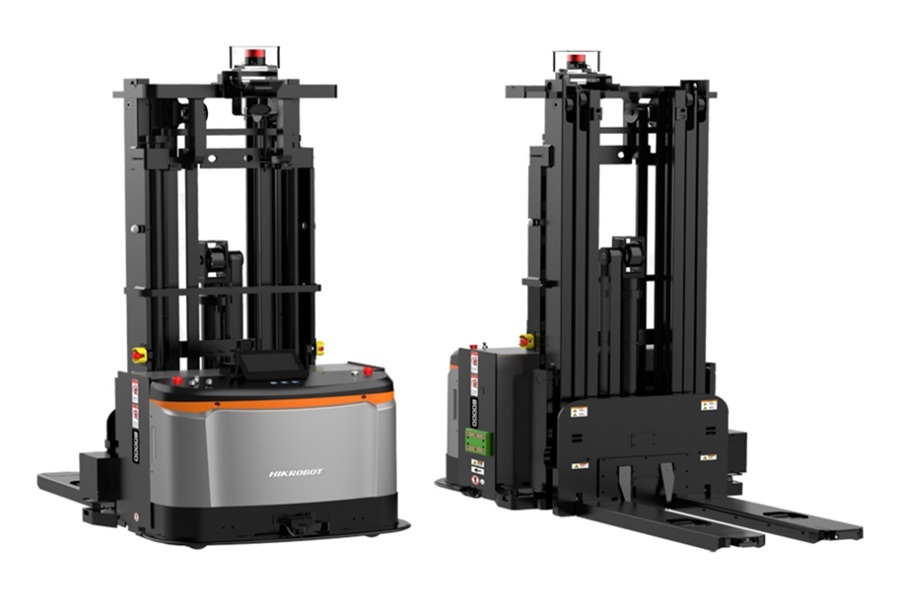
A well-structured forklift mobile robot range should include configurations for pallet carrying as well as stacking, allowing buyers to compare vehicles around the actual transfer height and carrier rather than treating every forklift robot as interchangeable.
Rack putaway requires lift and aisle checks together
For vertical storage, rated load alone is insufficient. Lift height, load center, mast clearance, rack tolerance, fork geometry, turning space, and final positioning all affect whether a pallet can be placed consistently.
The F4-1000C Forklift Mobile Robot provides a concrete reference: its current product page lists a 1,000 kg rated load, 2,031 mm fork lifting height, 2,062 mm minimum aisle width, and L-SLAM or customizable 3D L-SLAM navigation. These figures are useful for initial screening, but the supplier must still verify the buyer's pallet, rack, floor, and safety clearances.
Heavy pallets change stopping and stability requirements
Higher payloads increase the importance of load stability, braking behavior, floor condition, and transfer design. For projects requiring up to 3,000 kg rated capacity, the F3-3000 Forklift Mobile Robot is a relevant horizontal-transport reference; its published specification lists a 3,000 kg rated load and 200 mm fork lifting height.
Buyers should require bidders to report both the vehicle's nominal rated load and the allowable load for the project's actual lift height and load-center condition. Final selection still requires the load drawing and center-of-gravity information, because a compact pallet and a long irregular frame of equal weight do not impose the same engineering demands.
How Should Buyers Evaluate Navigation and Safety
Navigation should be assessed in the environment where the robot will work, while safety should cover the entire operating lifecycle. A demonstration in an empty aisle does not prove reliable performance around people, forklifts, racks, machines, doors, reflective materials, and changing obstacles.
Navigation must support repeatable transfer
Laser SLAM and related localization methods can support flexible deployment without a continuously fixed physical guide path, but successful pallet handling also depends on approach geometry and final docking.
The project may require pallet-position recognition, station landmarks, vision assistance, or mechanical alignment. Buyers should request evidence that the proposed method can achieve the required pickup and placement tolerance under real lighting, traffic, and load conditions.
Safety is a system responsibility
A forklift AGV may include obstacle detection, collision strips, emergency stops, alarms, and load or fork monitoring, yet safe operation still depends on route rules and site controls. The risk assessment should address blind intersections, protruding loads, pedestrian access, manual recovery, charging, fire doors, maintenance, and changes made after commissioning.
Any required regional standard or certification should be confirmed for the exact product and deployment rather than assumed from a general product-family statement.
Why Do Software Integration and Service Matter
The vehicle completes only the physical move. Reliable material handling automation also requires task generation, dispatch, traffic control, equipment handshakes, status feedback, exception handling, and operational support. Buyers should therefore evaluate the supplier's software and delivery capability alongside the robot hardware.
Define the information flow before commissioning
Clarify whether tasks originate in ERP, MES, WMS, a production cell, or an operator interface; then define which system assigns the robot, reserves the route, confirms pickup, records delivery, and manages exceptions.
Conveyors, doors, elevators, racks, and machines need explicit handshake logic. A well-designed architecture prevents duplicate missions, stranded pallets, ambiguous status, and lengthy disputes over which system owns recovery.
Look for support across the project lifecycle
Professional buyers should ask who performs site assessment, layout and simulation, mechanical customization, software development, installation, testing, operator training, spare-parts planning, and after-sales service.
The proposal should assign an owner, deliverable, completion criterion, and exclusion to each project stage. This lifecycle view is particularly important when a pallet project spans robots, warehouse systems, peripheral equipment, and production interfaces.
What Should Be Included in a Supplier Comparison
A useful comparison gives every bidder the same operating data and requires answers in the same format. This makes technical differences visible and prevents an attractive vehicle price from hiding additional integration, infrastructure, or support costs.
Compare measurable requirements rather than slogans
The request for proposal should cover pallet and load compatibility, vehicle dimensions, aisle and turning requirements, lift height, navigation, positioning and docking, safety functions, runtime, charging, throughput assumptions, software interfaces, peripheral equipment, commissioning tests, documentation, training, warranty, and service response.
It should also list exclusions and site responsibilities, including floor repairs, Wi-Fi coverage, charging power, barriers, and equipment modifications.
Require a transparent throughput calculation
Each bidder should show the calculation used to convert route and task data into peak-hour capacity. The input sheet should separate loaded and unloaded travel time, pickup time, drop-off time, turning and docking allowances, charging allowance, expected traffic delay, availability factor, and required peak-hour cycles.
Assumptions should be visible so the buyer can test how congestion, battery strategy, or a slower transfer changes the proposed fleet requirement.
Require a testable acceptance plan
Acceptance should be tied to repeatable tasks under agreed conditions: correct pallet pickup, safe loaded travel, accurate delivery, recovery from blocked routes, charging behavior, system status exchange, and sustained throughput over a representative period. For complex sites, simulation or a pilot route can expose congestion and interface gaps before the full fleet is installed. The supplier and buyer should agree on pass criteria, test data, and responsibility for unresolved exceptions.
Acceptance matrix field |
Required record |
Test scenario |
Normal flow, peak flow, blocked route, charging, recovery, and system-interface cases |
Load and pallet |
Actual carrier ID, dimensions, weight, load center, condition, and orientation |
Route condition |
Start and end points, aisle, traffic state, floor, doors, and transfer equipment |
Required result |
Target pickup, travel, placement, status feedback, safety response, and cycle time |
Sample size |
Agreed number of consecutive cycles and representative operating period |
Pass or fail record |
Measured result, timestamp, evidence, deviation, retest, and approval |
Exception owner |
Named party responsible for diagnosis, correction, retest, and closure |
Choosing an Experienced Automation Partner
Wesar Intelligence Co., Ltd. publishes a scope covering forklift mobile robots, warehouse software, equipment integration, project execution, and after-sales support. Buyers can use the same pallet, route, software, throughput, and acceptance checklist described above to verify whether that scope fits their project. The recommendation remains conditional on the selected vehicle configuration, site assessment, interface definition, and agreed acceptance tests.
Source note: The F4-1000C and F3-3000 specifications referenced above were checked against Wesar's current official product pages on September 10, 2026. Final project specifications remain subject to the selected configuration and site assessment.
Conclusion
The right forklift AGV supplier does more than match payload to a model number. It verifies the pallet, route, rack, transfer geometry, safety conditions, throughput, charging plan, software interfaces, acceptance tests, and service responsibilities as one automated pallet handling project. Buyers who follow this process can compare proposals on operational fit rather than marketing claims and reduce the risk of expensive redesign after installation.
Submit your pallet drawings, load-center data, route layout, transfer heights, target cycles per hour, and software-interface list through Wesar's request a technical consultation form for an application review.
FAQs
What information does a forklift AGV supplier need for a quotation
Provide pallet and load drawings, minimum and maximum weight, load-center data, pickup and placement heights, route and aisle dimensions, a floor map, rack drawings, floor conditions, required cycles per hour, shift pattern, charging expectations, Wi-Fi and network information, safety constraints, regional compliance requirements, and ERP, MES, WMS, PLC, or equipment interfaces.
Can one forklift AGV handle both transport and rack stacking
Some stacking models can perform both functions, but the best choice depends on payload, lift height, aisle width, rack geometry, cycle time, and the proportion of floor-level versus elevated moves. A supplier should compare the combined task with separate transport and stacking configurations.
How should buyers compare forklift AGV quotations
Use one requirement sheet and compare total project scope, including robot hardware, charging, software, integration, site modifications, commissioning, testing, training, documentation, warranty, spare parts, and service. Confirm all assumptions and exclusions before comparing total cost.
Filed in: / Logistics / Forklifts
Advertising