
Where to Stay in Rabat With a Rental Car: Agdal, Hassan, Hay Riad or the Medina?
Published: 22.AUG.2026



Rabat is one of those capitals where a car is often more useful for the freedom it gives you beyond the city centre than for getting around the centre itself. The Medina, Kasbah of the Oudayas, Hassan Tower and the main central districts are generally better explored on foot. Add the Atlantic coast, Bouknadel, Salé or a few days outside the capital, however, and having your own car starts to change the trip considerably.
That is why choosing where to stay should involve more than simply looking at the distance to the Medina. Through RentGo Rabat, travellers can compare offers from local rental providers, but before choosing a vehicle it is worth understanding where the car will stay overnight, how easy it is to leave the neighbourhood and whether the vehicle will actually be needed for everyday journeys.
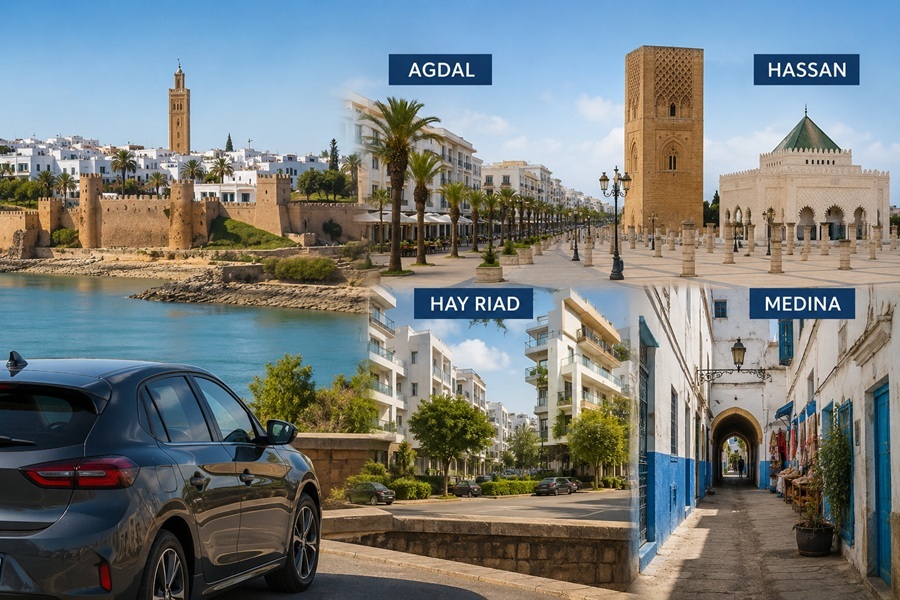
Agdal combines restaurants, modern city life and easy access to road trips. Hassan is better positioned for a first introduction to historic Rabat. Hay Riad suits longer stays and frequent driving. The Medina is the stronger choice for atmosphere, with less convenient car access as the trade-off.
Which Area of Rabat Should You Choose?
Area |
Best For |
What About the Car? |
Agdal |
First visits, restaurants, city life plus road trips |
Convenient for regular daytime drives |
Hassan |
Historic sights and shorter stays |
Mainly useful outside the centre |
Medina |
Riads, old-city atmosphere and local character |
Better left in suitable parking while you walk |
Hay Riad |
Longer stays, modern apartments and frequent driving |
One of the easiest areas for regular car use |
Souissi |
Quiet residential surroundings and more spacious accommodation |
A car becomes much more important |
Agdal: The Best Balance Between City Life and Road Trips
Agdal does not try to compete with the Medina for historic atmosphere. Its strength is different. This is a lively modern district where restaurants, cafés, shops and everyday services are close to accommodation, so returning from a road trip does not mean driving into the old city just to find dinner.
For a five or seven-day stay, that balance works particularly well. Some days can be spent without the car, while others can begin with a straightforward departure from the city.
Agdal also suits travellers who prefer a modern hotel or apartment rather than a traditional riad inside the Medina.
When Agdal Works Particularly Well
This area deserves a high place on the shortlist when the trip extends beyond the historic centre.
One day can be dedicated to the Medina and Oudayas, the next can stay within Rabat, and another can begin with a drive to the Jardins Exotiques de Bouknadel or continue farther along the coast.
In this type of itinerary, easy access to the car matters more than having the most dramatic view from the hotel room. There is little value in beginning every driving day with a complicated exit from the densest part of the old city.
Hassan: A Strong Base for a First Visit to Rabat
Quartier Hassan sits close to one of the capital's most recognisable historic areas. Hassan Tower and the Mausoleum of Mohammed V fit naturally into a walking itinerary, while the Medina, Bou Regreg and other central districts remain relatively close.
For a stay of three or four nights, this is a very logical choice.
The car does not need to be used every time you move around the city. Its real advantage appears on the days when the itinerary extends beyond the central districts.
Hassan or Agdal?
For a short first visit focused mainly on historic Rabat, Hassan has the advantage.
For a week combining the city with several road trips, Agdal usually provides a more flexible base.
The choice is better made according to how you expect to spend your evenings rather than a small difference in distance on the map. Hassan keeps you closer to historic Rabat. Agdal offers more modern restaurants, cafés and everyday services.
The Medina: The Most Atmospheric Option, With a Compromise for Drivers
Rabat Medina feels different from the modern parts of the capital not only because of its architecture. Narrow streets, small shops, craft workshops, Rue des Consuls and Souika create an environment that a standard city hotel cannot reproduce.
This is where staying in a traditional riad makes the most sense.
But the car and the Medina serve different purposes. The vehicle is useful for reaching the area and leaving the city the next day. Inside the old quarter, walking is the more natural way to get around.
Do Not Book a Riad Without Checking Access
An address on a map does not always show how close a car can realistically get to the property.
Before paying for accommodation in the Medina, check:
● where the recommended parking area is located;
● the actual walking distance from the car to the riad;
● whether the vehicle can approach more closely for luggage drop-off;
● whether staff can help with luggage;
● which parking option is recommended overnight.
For two or three nights, a short walk with luggage may be a perfectly reasonable compromise for the atmosphere of a riad. For a week involving daily drives, Agdal or Hassan will often be easier.
Kasbah of the Oudayas: Do Not Drive From Sight to Sight
The Kasbah of the Oudayas works best as part of a larger walking day that also includes the Medina and the Bou Regreg area.
Its white and blue streets, Andalusian garden and views towards the river and Atlantic are better experienced on foot than through a sequence of short car journeys.
Arrive in the area, park and spend a few hours walking. That is far more practical than trying to create a driving route between neighbouring landmarks.
Chellah: Another Reason Not to Spend the Whole Day Behind the Wheel
Chellah is one of Rabat's key historic sites. The archaeological complex combines remains from different periods of the city's history and deserves time for a proper walk.
A car is useful for reaching the site from another district, but its role ends there.
Chellah fits naturally into a day exploring Rabat rather than becoming a separate road trip. This approach allows the car to add flexibility without turning the holiday into a constant search for the next parking space.
Hay Riad: When the Car Becomes Part of Everyday Life
Hay Riad shows the modern side of the capital. Avenue Annakhil, newer development, offices, residential complexes and a greater sense of space create an atmosphere very different from the Medina or Hassan.
For a first tourist night, it is not the most obvious choice. For a longer stay with a car, the calculation changes.
Frequent drives, modern apartments, business travel or accommodation for a week or longer can make Hay Riad more practical than the historic centre.
Who Probably Does Not Need Hay Riad?
For a first visit lasting only two or three days, choosing this district only because of a modern hotel is not always the best use of the location.
If the main priorities are the Medina, Oudayas, Hassan Tower and central Rabat, you may find yourself repeatedly travelling back to places you could have reached on foot from a more central base.
Souissi: A Quieter Rabat With Greater Dependence on a Car
Souissi feels very different from the tourist centre. There are more residential streets, villas, greenery and open space.
The district is more appealing for longer stays, family trips or travellers looking for larger accommodation than for a classic city break.
The quieter surroundings come with a trade-off: many everyday journeys are easier by car.
For anyone who wants to step outside the hotel and immediately start walking through historic Rabat, there are better choices. For a stay lasting several weeks, the priorities may be completely different.
Is Salé Worth Considering?
Salé lies on the opposite side of the Bou Regreg, but it should not be treated simply as a cheaper extension of Rabat. It is a separate historic city with its own Medina, craft traditions and everyday local life.
For a repeat visit, staying here can be interesting.
For a short first trip when most of the itinerary remains in Rabat, a lower hotel price may matter less than the additional daily logistics.
Salé is therefore better chosen for a specific property, its atmosphere or a particular itinerary rather than simply because it appears cheaper.
When Salé Works Particularly Well
The area can make sense for a longer stay or for travellers planning to head north frequently.
It can also appeal to visitors who have already seen Rabat's main sights and want a less tourist-oriented setting.
In that case, parking and access from the exact property become especially important. The difference between two addresses in Salé may matter more than the simple fact of staying on the opposite side of the river.
Rabat as a Base for Road Trips
A rental car in Rabat makes the most sense when there is a clear plan beyond the city.
The Jardins Exotiques de Bouknadel are only a short drive from the capital. Farther north, the route can continue along the coast or towards Asilah, Tetouan and Chefchaouen.
This is where a car offers something a direct train cannot: the freedom to stop in a smaller town, change the route after lunch or stay overnight somewhere that was originally planned as only a short stop.
Not Every Intercity Trip Requires a Car
Having a rental car does not mean it must be used for every destination.
Rabat has good rail connections with Casablanca and Tangier, as well as other major cities on Morocco's railway network.
When the only goal is to spend a day in central Casablanca without making stops along the way, the train may be simpler.
The car becomes more valuable for routes where flexibility, several destinations in one day and places outside the main rail corridors matter more.
Where to Drive From Rabat for a Day
A useful road trip does not have to involve several hundred kilometres.
Bouknadel works well for an easy day close to the capital. The coast allows the route to be adjusted according to the weather and available time. With an earlier start, longer destinations also become possible.
The basic rule is simple: one day does not need to contain the maximum possible number of place names. Choose one direction and leave room for an unplanned stop.
Chefchaouen: Better With an Overnight Stay When Time Allows
Chefchaouen often appears on lists of day trips from Morocco's major cities, but from Rabat it is already a substantial journey.
When the schedule allows, spending one night in the north makes the trip considerably more rewarding. There is no need to arrive, rush through the Medina and immediately start calculating the hours remaining for the return drive.
For a longer road trip, it is even more logical to include Asilah or Tetouan and continue gradually rather than returning to Rabat after every city.
Do Not Turn Rabat Into a Parking Stop Between Road Trips
The capital deserves at least a few full days without long drives.
The Medina, Oudayas, Hassan, Chellah, Bou Regreg and the modern districts offer enough variety to justify staying in the city rather than leaving every morning.
For a week-long visit, alternating works well: a day in Rabat, one road trip, another city day, then a longer drive.
This way the car adds freedom without dictating the pace of the holiday.
Where to Stay for 3 or 4 Nights
For a short first visit, Hassan and Agdal are the strongest options.
Hassan gives easier access to historic Rabat.
Agdal works better for travellers who want a modern environment, restaurants and at least one full driving day.
The Medina should be chosen for the experience of staying in a riad. In that case, less convenient car access is a deliberate trade-off rather than a surprise.
Where to Stay for a Week
For seven days, Agdal becomes particularly strong.
The district does not force a choice between city life and road trips. The car can be left unused for a full day in Rabat, then used the next morning for a longer journey without changing hotels.
Hassan remains a good option when the itinerary is more city-focused.
Hay Riad becomes more competitive when the car will be used almost every day or modern apartments are preferred for a longer stay.
10 or 14 Days: Change Cities, Not Neighbourhoods
On a longer trip, there is little value in checking out of a hotel in Agdal just to spend the next three nights in Hassan.
That move changes very little geographically.
A much better approach is to spend the first part of the trip in Rabat, then continue north or farther into Morocco and stay for several nights in another city.
This is the kind of change of base that actually reduces repeated driving and allows the car to work as a travel tool rather than simply transport between the hotel and individual sights.
Parking: Check It Before Booking Accommodation
A mention of parking in a hotel description does not always mean a private guaranteed space.
Before paying, check:
● whether the property has its own parking;
● whether a space can be reserved;
● where the car stays overnight;
● whether luggage can be unloaded easily;
● whether the garage has restrictions;
● how easy it is to leave in the morning;
● whether daily routes require driving through the busiest central streets.
For the Medina, the final kilometre matters particularly. A hotel can be excellent for walking and still be inconvenient for daily access to the car.
What Kind of Car Do You Need in Rabat?
For the city itself and normal paved intercity routes, a large SUV is unnecessary.
A compact or mid-size car is easier to use in urban areas and simpler to park near accommodation.
For a longer road trip, seat comfort, luggage space and the overall vehicle class become more important. Saving money on the smallest possible model makes little sense when several hours on the road have to be spent with luggage inside the passenger compartment.
Families should check actual boot capacity rather than relying only on the advertised number of seats.
Right-Hand Traffic and the First Hours Behind the Wheel
Traffic in Morocco moves on the right.
For many European drivers, the side of the road will already feel familiar, although the rhythm of urban traffic may still require some adjustment.
After collecting the vehicle, it is better to drive to the accommodation first and become familiar with the car. There is little advantage in making the first journey through the densest part of the city immediately after pickup.
What to Check Before Booking a Rental Car
The daily rate shows only part of the rental conditions.
Before confirming the vehicle, check the deposit, accepted payment methods, physical card requirements, insurance excess, major insurance exclusions, fuel policy, mileage, additional driver conditions and the rules for collection and return.
Mileage is particularly important for a road trip. Conditions that barely matter for a few short drives around Rabat can become significant when several cities are included.
No credit card and no deposit describe different rental conditions. A car available without a credit card may still require a deposit, while no deposit does not automatically mean zero excess.
Agdal, Hassan, Hay Riad or the Medina: The Final Choice
Choose Hassan for a short first visit when historic Rabat is the main priority.
Agdal offers the best balance for a week combining the city with several road trips.
The Medina is stronger for atmosphere. It suits travellers who are comfortable leaving the car outside the narrowest streets and want the experience of staying in a traditional riad.
Hay Riad works better for longer stays, modern accommodation and regular driving.
Souissi is worth considering for quieter surroundings and more space, while Salé is more interesting for a repeat visit or a specific itinerary than as an automatically cheaper alternative to central Rabat.
Before booking accommodation, mark three things on the map rather than ten tourist attractions: where you expect to spend your evenings, how many full days will remain in Rabat and on which days you genuinely plan to leave the city. Once those three points are clear, choosing the right area becomes much easier. A good base in Rabat does not need to be closest to every landmark. It needs to remove unnecessary repeated journeys from the trip.
Filed in: / Services / Car Rental
Advertising